



Four months ago, a Sales & Leasing Director called me in frustration. A member of her team had just spent four hours updating pricing and availability across 47 unit types in preparation for the summer booking window. The task was straightforward but mind-numbing: adjust rates for different date ranges, ensure consistency across similar unit types, update minimum stay requirements. “There has to be a better way,” she said. “This can’t be the best use of our time.”
By Fred Lerche-Lerchenborg, CEO, Lavanda
She’s right, of course. But her frustration captures something fundamental about where our industry finds itself in 2025. We’re managing increasingly complex portfolios with increasingly sophisticated strategies, yet much of the work remains manual, repetitive, and frustratingly time-consuming.
The conversation about artificial intelligence in property management has, until recently, felt somewhat theoretical. We’ve all read the headlines about AI transforming industries. We’ve attended conference sessions about LLMs, agentic workflows, machine learning and automation. But for most operators, the question has remained: what does this actually mean for my day-to-day work?
I think we’re finally starting to get some concrete answers.
The reality of portfolio complexity
Let’s be honest about what running a modern student accommodation portfolio actually involves. You’re not just managing physical assets; you’re orchestrating an intricate system of pricing strategies, allocation policies, financial reporting, operational workflows, and regulatory compliance. All while trying to maintain consistent standards across multiple sites, respond quickly to market conditions, and provide excellent experiences for students.
The challenge isn’t any single task. It’s the cumulative weight of hundreds of small operational decisions and actions that need to happen correctly, consistently, and quickly across your entire portfolio.
Consider a typical scenario: you need to prepare a building for the new academic year. This involves creating dozens of unit configurations, setting up pricing structures, establishing booking policies, configuring automation rules, preparing operational documentation, and briefing your team. Traditionally, this might take several days of focused work, with inevitable inconsistencies and the risk of human error when you’re setting up your hundredth unit type.
Or take portfolio reporting. Your investors want to understand booking pace trends, occupancy forecasts, and revenue performance across different unit categories and locations. Extracting this data, ensuring it’s accurate, formatting it meaningfully, and presenting it coherently can consume significant time. Time that could be spent acting on the insights rather than generating them.
AI as a practical tool, not a magic wand
Here’s what I’ve learned about AI in our industry: it’s not about replacing human judgment. It’s about eliminating the friction between intention and execution.
The most valuable AI applications aren’t the flashy, futuristic ones. They’re the unglamorous tasks that free up your team to focus on what actually requires human expertise: strategy, relationship management, problem-solving, and decision-making.
Take the Sales Director I mentioned earlier. Today, she describes what she wants her team to achieve in plain English: “Increase weekend rates by 15% for all ensuite rooms in Manchester properties during July and August, but keep Monday – Thursday rates unchanged.” What previously took four hours of manual updates now takes four minutes. The AI understands the intent, identifies the affected inventory, applies the logic consistently, and confirms the changes.
This isn’t science fiction. This is happening now, in live operational environments.
But here’s the critical part that’s often overlooked: for AI to be genuinely useful, it needs to have access to all the data in your property management system. It’s not enough to have a chatbot that can answer general questions. The AI needs to comprehend your business context, your operational workflows, and the specific logic of how your portfolio operates. This requires a seamless integration between the AI and your PMS – not a bolt-on feature, but a fundamental part of how the system is designed.
Real-world applications that matter
Let me share some examples of where we’re seeing immediate, tangible impact:
Operational setup and configuration
When onboarding a new building, operators traditionally face hours of data entry: creating unit types, configuring amenities, setting up pricing structures, establishing availability rules. With AI assistance, you can describe your building’s configuration conversationally – “I have 180 units across 6 unit types, with varying amenity packages” – and have the system generate the entire setup in minutes rather than days. The AI asks clarifying questions, suggests best practices based on similar buildings, and ensures consistency across your portfolio.
One of our operators recently onboarded a 200-unit building using AI-assisted setup. The process, which historically took three days, was completed in under four hours. More importantly, the configuration was more consistent and comprehensive than manual setups typically achieve.
Data analysis and decision support
Portfolio managers need to understand performance trends, identify opportunities, and spot potential issues early. But generating meaningful insights often requires combining data from multiple sources, creating complex queries, and formatting results into digestible visualisations.
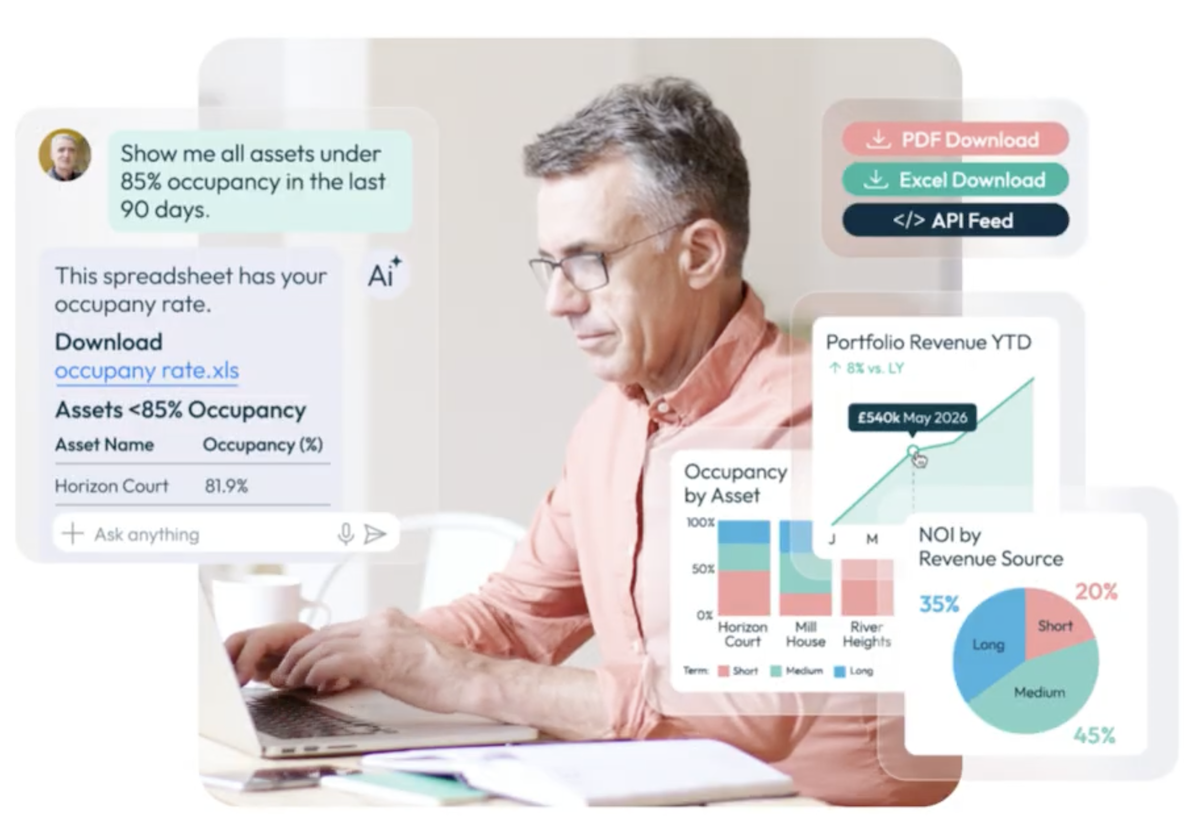
AI can now handle this conversationally. “Show me the booking pace for all London buildings compared to last year, broken down by unit type” produces an immediate, accurate analysis with appropriate visualisations. “Which buildings are underperforming against their occupancy targets for September move-in?” identifies specific properties requiring attention.
But the real transformation goes beyond just getting answers. Because AI has ever-advancing visualisation capabilities, your team can now create presentation-ready materials in seconds. A portfolio manager can ask “create a chart showing our Q4 occupancy trends by region”, review the visualisation, then say “convert this into a slide for tomorrow’s board meeting with our key takeaways highlighted.” The entire process – from question to polished presentation material – takes less than a minute.
This fundamentally democratises data across your organisation. You no longer need technical expertise or design skills to create compelling, accurate visualisations. Junior team members can generate the same quality of analysis and presentation materials as senior analysts. The barrier between having a question and being able to communicate the answer effectively disappears entirely.
This transforms portfolio management from reactive to proactive. Instead of discovering problems in monthly reports, you can ask questions as they occur to you, get instant answers, and immediately share insights with your team in a format that drives action.
Documentation and knowledge management
Every operator knows the challenge of maintaining comprehensive, current documentation. Operational procedures, onboarding materials, training guides, policy documents – keeping these updated and accessible is crucial but time-consuming.
AI can now generate and maintain documentation automatically. When you update a workflow in your system, documentation updates simultaneously. When a team member has a question, they can ask conversationally rather than searching through folders of outdated PDFs. For new staff onboarding, AI can create custom training materials based on their role and experience level.
This is particularly valuable in the context of student accommodation, where teams often experience seasonal turnover. Knowledge that previously existed only in the heads of experienced staff can now be captured, structured, and made accessible.
Compliance and reporting
Across Europe, the regulatory requirements imposed on student accommodation operators continue to expand. Right to rent checks, health and safety documentation, financial reporting, licensing compliance – the administrative burden is substantial and the stakes are high.
AI can now help manage these requirements proactively. It can track compliance deadlines, flag missing documentation, generate required reports, and even draft responses to routine regulatory queries. This doesn’t eliminate the need for human oversight, but it dramatically reduces the risk of oversights and the time spent on compliance administration.
Building for an AI-first future
The applications I’ve described aren’t theoretical possibilities – they’re live capabilities being used by operators today. But getting here required a fundamental rethinking of how a PMS should be designed.
At Lavanda, we made a strategic decision early on to build our platform with AI integration at its core, not as an afterthought. Our “AI-first” approach means Lavanda OpenPMS is designed from the ground up to work seamlessly with emerging tools, with data structures that AI can understand and APIs that enable natural, conversational interaction.
This matters because bolt-on AI solutions, no matter how sophisticated, will always be limited by the underlying system’s ability to support them. True transformation requires the property management system itself to be designed for AI interaction.
We’ve been fortunate to develop this approach through deep partnerships with leading operators across Europe – portfolio managers, revenue teams, operations directors who’ve helped us understand exactly which workflows need AI assistance and how that assistance should work in practice. Their operational expertise, combined with our technology focus, has enabled us to deliver capabilities that address real needs rather than imagined ones.
The use cases in this article aren’t aspirational. They’re describing what happens when you combine operator insight with purpose-built AI infrastructure.
What this means for the industry
I believe we’re at the beginning of a significant shift in how student accommodation portfolios are managed. Not because AI will replace property managers. It won’t. But because it will fundamentally change what property managers spend their time doing.
The Leasing team that spent four hours on pricing updates aren’t going to lose their jobs. They are going to spend those four hours on strategic pricing decisions, building relationships with university partners, improving student experiences, or developing new revenue opportunities. The value doesn’t disappear; it multiplies.
For investors, this matters because operational efficiency directly impacts returns. Portfolios that can respond faster to market conditions, maintain more consistent standards, generate better insights, and operate with leaner overheads will outperform. The competitive advantage isn’t just having AI; it’s using it to enable better decision-making and faster execution.
For students, the benefits are indirect but real. Staff who spend less time on administrative tasks can invest more time in resident support, community building, and service quality. Pricing optimization means better value and availability. Operational consistency means fewer surprises and better experiences.
The path forward
If you’re reading this and thinking “this sounds interesting but complicated,” I totally understand. It’s only natural that new ways of working, underpinned by new technology, might appear daunting.
But here’s the encouraging part: the best AI applications are the ones you barely notice you’re using. They feel like natural extensions of how you already work, not completely new systems requiring extensive training.
The key is starting with specific, high-value problems rather than trying to transform everything at once. Pick the manual task that most frustrates your team. Explore how AI might address it. Learn from the experience. Then expand.
We’re also learning that deployment timelines are compressing dramatically. What previously required months of implementation and training can now be achieved in hours or days. This changes the risk profile considerably – you can experiment, learn, and adjust quickly rather than making large, irreversible commitments.
A practical perspective
Let me be blunt: AI isn’t going to solve all your operational challenges. It won’t fix poor strategy, replace the need for skilled staff, or eliminate the complexity of managing student accommodation portfolios.
What it will do is remove much of the friction between intention and execution. It will make your existing team more productive, your operations more consistent, and your decision-making more informed. It will free up time and mental energy for the work that actually creates value.
The question isn’t whether AI will become part of our industry. It already is. The question is how quickly operators will identify where it can add value and begin putting it to work.
For those willing to engage with these tools practically and thoughtfully, the opportunity is significant. Not because the technology is revolutionary, but because the problems it solves are deeply familiar to anyone managing a student accommodation portfolio.
And that Sales Director I mentioned? She and her team now spend their Monday mornings analysing market trends and developing pricing strategies rather than updating spreadsheets. That feels like progress worth pursuing.
Fred Lerche-Lerchenborg is CEO of Lavanda, a leading PMS platform serving the PBSA and higher education sectors across Europe.