





A three-year Delta Media AI survey analysis finds concern about AI guardrails has barely changed, while women and men focus on markedly different risks.
Three years into real estate’s rapid embrace of artificial intelligence (AI), brokerage leaders remain nearly as worried about AI risk and liability as they were when Delta Media Group began tracking the emergence of real estate’s use of AI in 2024.
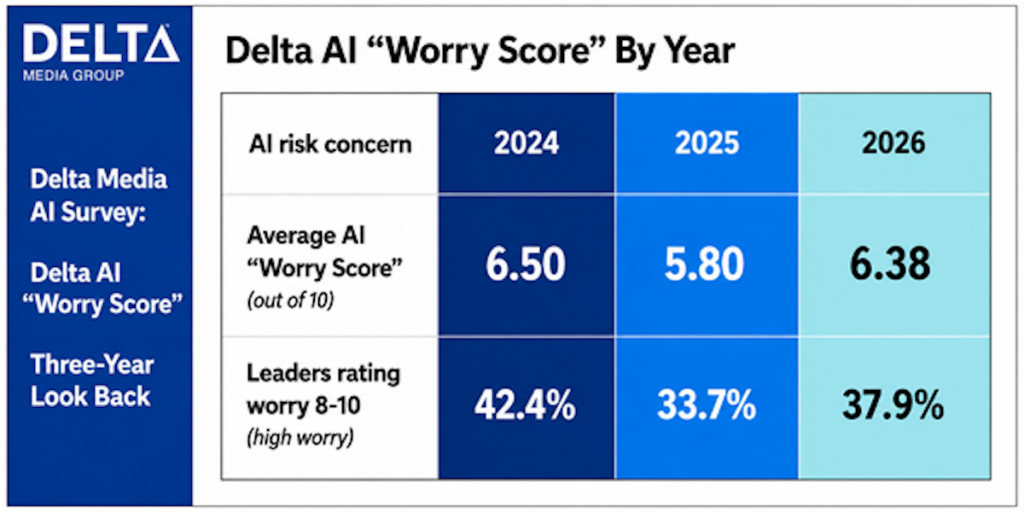
The average Delta AI ‘worry score’ among brokerage leaders asked whether AI lacks appropriate guardrails to limit risk or liability was 6.38 out of 10 in 2026, in contrast with 6.50 in 2024. Concern dipped to 5.80 in 2025 before rebounding this year, according to a new analysis of three years of respondent-level data from the Delta Media Real Estate AI Survey.
The 2026 findings reveal that AI worry is not the same for everyone. Women real estate leaders are more focused on regulatory compliance and data privacy than men, while male leaders are nearly twice as likely as women to identify uncertainty about AI costs and return on investment as a concern.
“One reason AI worry may be rebounding is that the decisions are getting bigger. Brokerages are moving beyond simple AI tools toward agentic AI, automation and systems that can take action.
“As AI becomes more powerful and more autonomous, choosing the right AI partner becomes a risk-management decision, not just a technology decision.
“Whether a brokerage decides to build, buy or rent its AI capabilities, leaders need to know who is handling their data, how the technology is being managed and what protections are in place. The cheapest or fastest option may not be the safest one.”
Michael Minard, CEO and Owner, Delta Media Group
Despite growing familiarity with AI, brokerage leaders’ concerns about its potential risks remain remarkably persistent. The average AI risk and liability worry score was 6.50 out of 10 in 2024, falling to 5.80 in 2025, before climbing back to 6.38 in 2026.
The share of brokerage leaders giving AI risk a high worry score of 8, 9 or 10 was 42.4% in 2024, 33.7% in 2025 and 37.9% in 2026. The 2026 average is now within just 0.12 points of where it stood when Delta Media first measured AI risk concerns three years ago.
The 2026 survey is the first in the three-year series to ask brokerage leaders about agentic AI tools that can automate tasks, reflecting how quickly AI has moved beyond generating content into systems capable of taking actions on a user’s behalf.
The survey does not establish that agentic AI caused the increase in worry. However, its emergence adds a new dimension to questions about guardrails, compliance, data security, liability and who ultimately is responsible when AI acts.
Among female brokerage leaders 71.4% named compliance with real estate regulations as an AI concern, compared with 39.1% of men. 65.7% identified data privacy and security risks, compared with 48.4% of men, and just 28.6% cited cost and ROI uncertainty, versus 51.6% of men.
The findings raise a distinction – women are not expressing greater concern about AI across the board. Instead, their concerns lean towards regulatory and data risks, while men show concern about AI’s financial return.
“What stands out is that women leaders aren’t simply more worried about AI. Their risk radar is pointed in a different direction. They’re much more focused on compliance and protecting data, while men are considerably more focused on cost and ROI.
“That distinction matters because AI risk is not one thing, and the safeguards a brokerage needs depend on where its greatest exposure lies.”
Michael Minard, CEO and Owner, Delta Media Group
The 2026 findings also illustrate concerns vary based on brokerage size. Among firms with 101 or more agents, concerns included data privacy and security risks at 61.2%, integration with existing systems at 56.7%, cost and ROI uncertainty at 52.2%, training agents and staff at 50.7%, and finally regulatory compliance at 44.8%.
However, the picture is very different among firms with 20 or less agents, with regulatory compliance at 75%, training agents and staff at 50%, data privacy and security risks at 43.8%, cost and ROI uncertainty at 25%, and finally integration with existing systems at 25%.
“AI vendors are not interchangeable. Brokerages need to look beyond features and ask harder questions about security, privacy, compliance, integration and ongoing governance.
“As AI becomes embedded in more workflows, selecting the right technology partner may become one of the most important risk-management decisions a brokerage makes.”
Michael Minard, CEO and Owner, Delta Media Group
Larger brokerages appear to be battling with the economics, technology infrastructure and data risks involved in deploying AI at scale. Smaller brokerages are more focused on staying compliant.
For smaller firms, that concern may be especially important because they typically have fewer internal resources to devote to evaluating AI systems, compliance and security. For larger organisations, the challenge grows with the number of agents, systems, integrations and data sources AI may touch.